Understanding Two Core Jewelry Fabrication Techniques
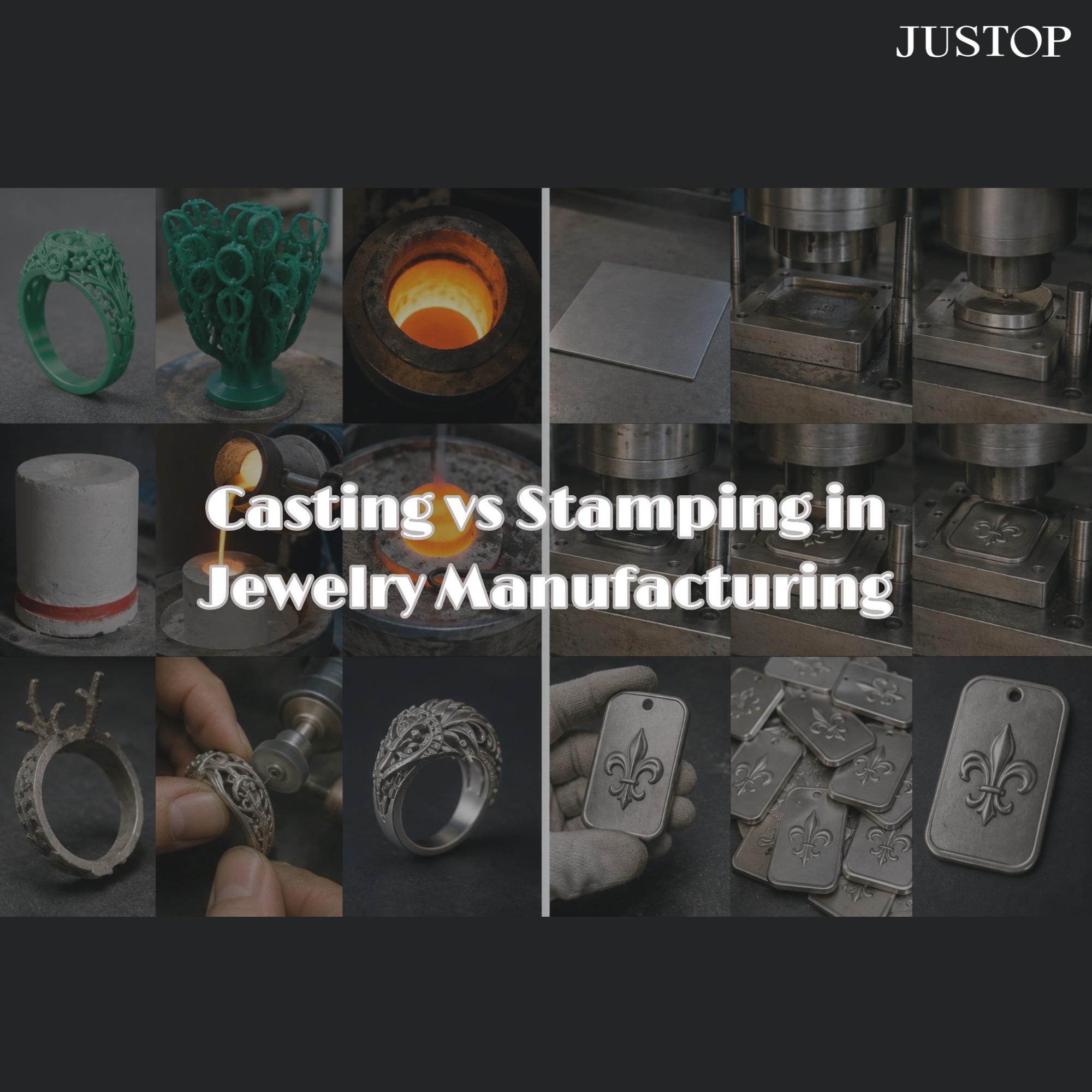
In modern jewelry design manufacturing, selecting the right production method is crucial for balancing creativity, cost, and efficiency. Among the most widely used jewelry fabrication techniques, the jewelry casting process and metal stamping jewelry stand out as two fundamentally different approaches. Simply put, casting is an additive method ideal for complex 3D forms, while stamping is a subtractive or forming method best suited for refined surface patterns on flatter designs.
How the Jewelry Casting Process Works
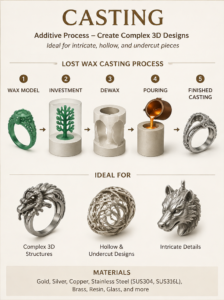
The jewelry casting process, especially lost wax casting jewelry (also known as investment casting jewelry), begins with creating a wax model. This model is encased in plaster, then heated so the wax melts away, leaving a cavity. Molten metal is poured into this mold, cooled, and finished into a detailed piece.
This method is one of the most versatile metal casting techniques, capable of producing intricate, hollow, or undercut structures in a single step. It is widely used in custom jewelry casting, where design freedom is essential. Materials range from gold and silver to stainless steel casting, including grades like SUS304 and SUS316L, though higher melting points require stricter temperature control and advanced equipment.
How Metal Stamping Jewelry Works
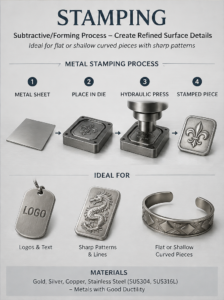
In contrast, metal stamping jewelry relies on precision metal forming. Sheets of metal are placed between custom steel dies and shaped under extreme pressure using hydraulic press jewelry systems. This process forms the metal in its solid state, creating clean, sharp patterns.
This approach is ideal for embossed metal jewelry, such as pendants, bangles, tags, or medallions with logos or geometric textures. As one of the most efficient metal forming processes, stamping allows for high-speed, large-scale production with minimal material waste and consistent quality.
Design Applications and Material Considerations
Casting excels in producing highly detailed, three-dimensional designs—such as sculptural rings or organic motifs—while stamping is better suited for flat or slightly curved surfaces with fine engraved or embossed details.
When working with stainless steel, both methods remain relevant. Stainless steel casting enables complex structures but comes with higher costs and longer production cycles. Meanwhile, stamping with SUS304 or SUS316L offers excellent durability, sharper details, and better suitability for mass production.
Pros, Cons, and Smart Choices
Casting offers unmatched design flexibility and detail reproduction but involves longer lead times, higher costs, and potential internal porosity. Stamping, on the other hand, delivers superior efficiency, strength, and lower unit cost—though it is limited in structural complexity.
Ultimately, the choice depends on your goals. For bold, intricate designs, casting remains essential. For clean, repeatable patterns at scale, stamping is the smarter option. In many cases, combining both jewelry fabrication techniques—such as casting a base form and applying stamped textures—can achieve the best of both worlds.