Choosing the right metal jewelry making techniques is essential for turning creative concepts into production-ready designs. Different manufacturing methods affect jewelry shape, surface details, production costs, and consistency. For jewelry designers, understanding these processes helps balance design creativity with manufacturing efficiency, whether developing custom metal jewelry or planning large-scale production.
Metal Forming Techniques for Different Jewelry Shapes
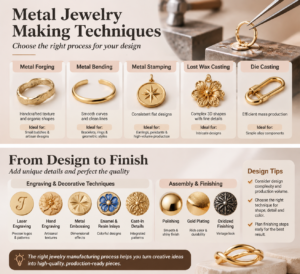
Metal forming determines the shape and structure of a jewelry piece. The best method depends on its complexity, material thickness, and production volume.
- Metal Forging: Uses hammering to create organic curves and handcrafted textures. Ideal for small batches and designs requiring an artisanal appearance.
- Metal Bending: Shapes metal wires and tubes into controlled curves, making it suitable for bracelets, rings, and geometric components.
- Metal Stamping: Uses dies to produce consistent flat or slightly curved metal components. It works well for pendants, earrings, and high-volume production.
- Lost Wax Casting: Creates complex three-dimensional shapes with good detail and repeatability. It is suitable for intricate jewelry designs and custom jewelry manufacturing.
- Die Casting: Uses high pressure to form alloy components efficiently, making it suitable for large production runs of relatively simple designs.
Which technique should designers choose? Forging and bending work well for handcrafted designs and prototypes, stamping is efficient for flat components, while lost wax casting is generally better for complex three-dimensional shapes.
Metal Engraving and Decorative Techniques
Surface decoration adds visual identity and distinctive details to metal jewelry. Different jewelry making techniques create different textures and finishes.
- Laser Engraving: Produces precise logos, lettering, and intricate patterns with clean edges. It is ideal for custom jewelry branding.
- Hand Engraving: Creates traditional decorative lines and handcrafted textures, although consistency can be harder to maintain in large batches.
- Metal Embossing: Adds raised or recessed patterns to metal surfaces for dimensional decorative effects.
- Enamel and Resin Inlays: Introduce color and decorative patterns through non-metallic materials.
- Cast-in Details: Incorporate raised patterns directly into the metal structure, although fine lettering may require additional laser engraving.
For sharp logos and fine text, laser engraving is usually preferable to casting. For colorful designs, enamel and resin decoration offer greater flexibility.
Jewelry Assembly and Metal Finishing
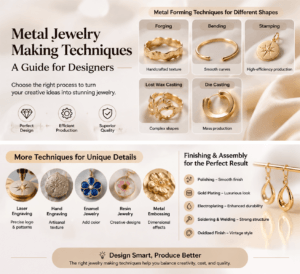
Beyond shaping and decoration, structural techniques and surface treatments determine the final appearance and functionality of jewelry.
Jewelry Assembly: Metal soldering and jewelry welding connect separate components, while metal riveting and mechanical fasteners allow connections without heat. Metal cutting also creates openwork patterns and lightweight structures.
Metal Finishing: Jewelry polishing creates smooth or mirror-like surfaces. Gold plating and electroplating add decorative metallic coatings, while oxidized finishes create darker recessed details and vintage-inspired effects.
These processes are often combined rather than used independently, so designers should consider material compatibility and assembly requirements early.
How to Choose the Right Jewelry Manufacturing Process
A successful jewelry design process involves three important decisions:
- Production volume: Choose forging or bending for handcrafted prototypes, and consider casting, stamping, or die casting for repeat production.
- Design complexity: Use casting for intricate three-dimensional shapes, stamping for flat components, and laser engraving for precise surface details.
- Finishing requirements: Plan polishing, plating, decorative inlays, and component connections before manufacturing begins.
From jewelry prototyping and mold making to production and metal finishing, every stage affects the final result.
Understanding these metal fabrication techniques helps designers reduce unnecessary production costs, improve product consistency, and develop jewelry collections that are both visually appealing and suitable for manufacturing.