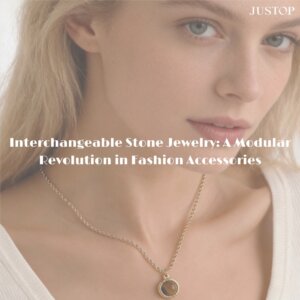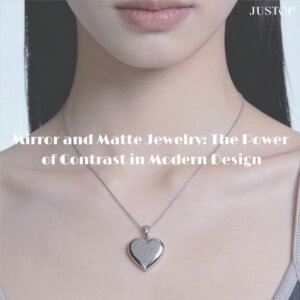
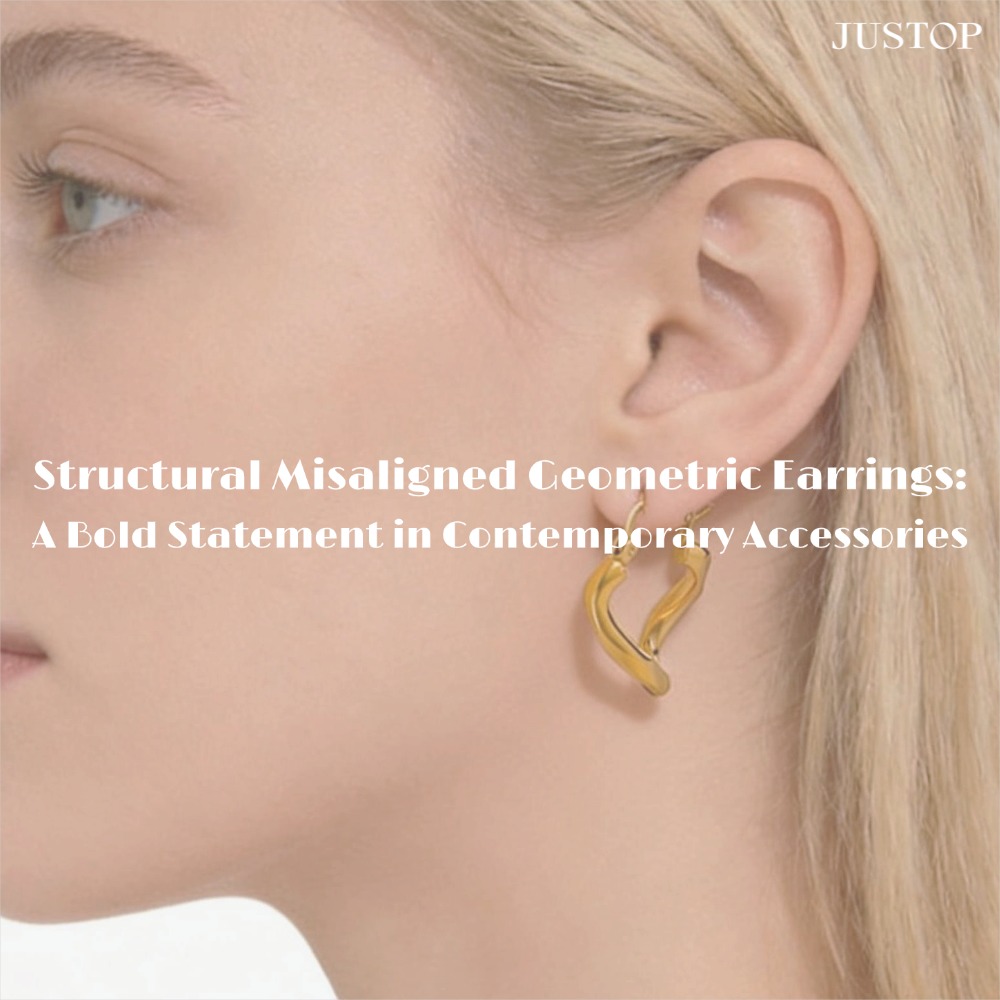
In today’s fashion jewelry landscape, symmetry is no longer the ultimate standard of beauty. Structural misaligned geometric earrings redefine balance through contrast, asymmetry, and spatial layering. Popular search terms such as asymmetrical earrings, geometric earrings, modern statement earrings, and architectural jewelry reflect growing demand for designs that feel bold, artistic, and unconventional.
Rather than focusing on traditional harmony, these earrings embrace offset structures, mismatched forms, and layered geometry. The result is visual tension that feels intentional—transforming static metal into dynamic wearable sculpture.
Artistic Roots: From Cubism to Deconstructivism
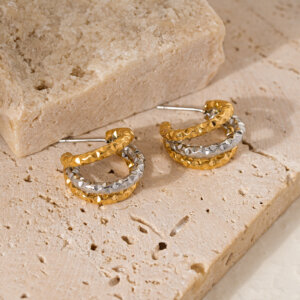
The aesthetic language of structural misalignment can be traced back to early 20th-century modern art. Artists like Pablo Picasso broke single-point perspective through Cubism, fragmenting objects into geometric planes. Around the same time, Russian Constructivist artists such as Vladimir Tatlin treated art as structure rather than decoration, emphasizing line, volume, and engineered form.
In architecture, deconstructivist pioneers like Zaha Hadid and Frank Gehry challenged rigid geometry with fragmentation and flowing asymmetry. Their influence is visible in today’s architectural earrings and abstract jewelry design, where miniature “buildings” frame the face.
Misalignment, therefore, is not chaos—it is controlled imbalance. It creates movement between the left and right ear, encouraging the eye to travel and discover.
Design Approaches: Creating Visual Tension
1. Intentional Asymmetry
The most direct method is mismatched earrings. One ear may feature a short geometric stud, while the other showcases a long dangle geometric earring. Searches for mismatched earrings for women show how consumers embrace individuality over uniformity.
2. Layered and Offset Structures
Within a single earring, designers rotate or shift geometric components. A circular hoop might intersect with an off-center bar; a cube frame may contain a tilted inner ring. This structural layering gives depth and aligns with trending minimalist gold earrings and modern silver earrings styles.
Danish brand Georg Jensen has explored modular layering concepts in its design language, demonstrating how offset forms can remain elegant and refined.
3. Deconstruction and Reassembly
Some designs fragment a shape entirely—splitting a circle into two semicircles worn separately, or unfolding a cube into a wireframe structure. These concepts resonate with searches for abstract earrings and contemporary art jewelry, appealing to fashion-forward audiences.
Materials That Support Structure
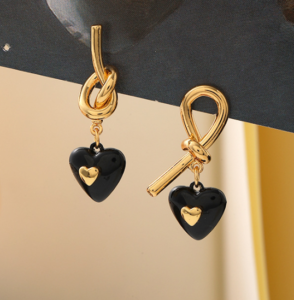
Metal forms the backbone of geometric earrings. Sterling silver, 14K gold, stainless steel, and titanium allow sharp edges and stable frameworks. Titanium, in particular, supports larger statement geometric earrings while remaining lightweight.
Mixed materials enhance the sense of displacement. Acrylic panels, resin, or wood paired with metal introduce texture contrast. A pearl accent within a rigid geometric frame adds softness, echoing trends in modern pearl earrings.
Craftsmanship: Precision Meets Handwork
Laser cutting ensures crisp geometric outlines, especially in flat metal or acrylic panels. For complex three-dimensional forms, 3D printing combined with lost-wax casting allows intricate internal structures. Final hand polishing and finishing soften edges and add warmth—preventing the design from feeling overly industrial.
A Contemporary Design Attitude
Structural misaligned geometric earrings combine rational form with emotional expression. They reflect confidence, independence, and a willingness to challenge tradition. In a market increasingly driven by bold fashion earrings and unique statement jewelry, this aesthetic stands out as both intellectual and wearable.
By embracing asymmetry and spatial contrast, geometric earrings move beyond ornament—they become a declaration of personal style.