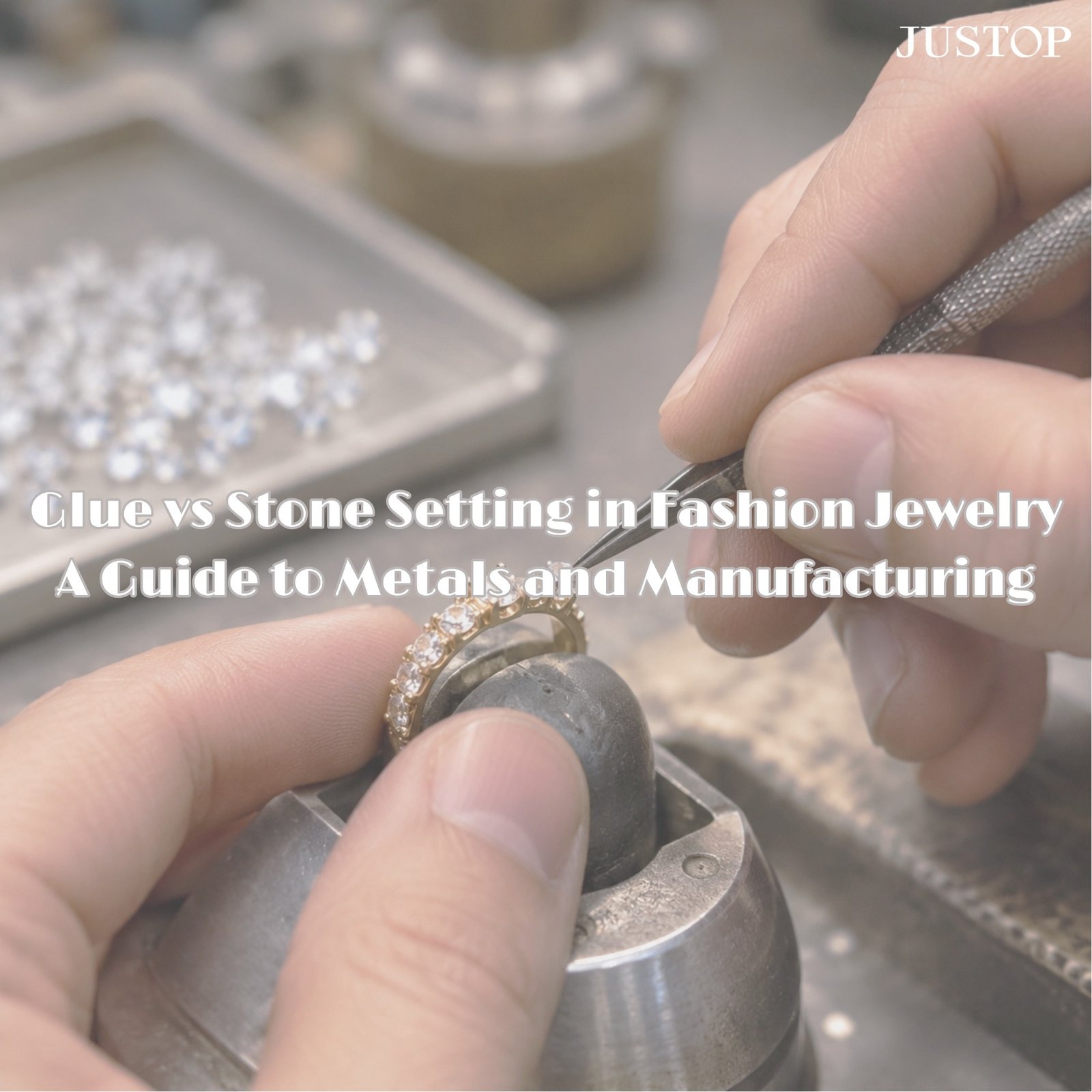
Fashion jewelry manufacturers often prefer glue setting over traditional stone setting because it offers greater production flexibility, works well with flatback rhinestones, and fits high-volume manufacturing processes. However, the choice between adhesive bonding, prong setting, bezel setting, and pavé setting depends on the metal material, stone structure, product design, and expected durability.
Understanding these differences helps jewelry designers, brands, and wholesale buyers choose suitable materials and manufacturing techniques for rhinestone jewelry collections.
Why Is Glue Setting Common in Fashion Jewelry?
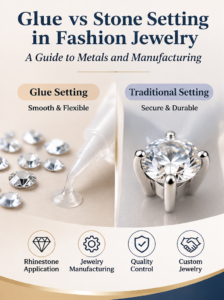
One major reason is compatibility between stones and metal structures. Flatback rhinestones have flat surfaces designed for adhesive bonding, while pointed-back cubic zirconia stones are generally more suitable for mechanical settings.
Using jewelry adhesive allows manufacturers to attach decorative stones without creating individual metal prongs or complex stone seats. It is particularly useful for stainless steel jewelry featuring multiple small rhinestones.
Production efficiency also matters. In many manufacturing processes, stones are glued after metal polishing and electroplating. This makes glue-on rhinestones easier to integrate into existing production workflows and supports flexible order quantities.
By comparison, traditional jewelry setting techniques require more precise metal structures and specialized craftsmanship.
How Different Metals Affect Stone Setting
Stainless Steel Jewelry: Adhesive Setting and CNC Processing
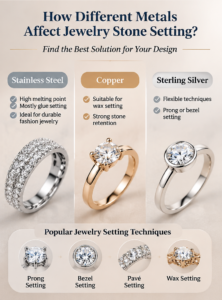
Stainless steel has a high melting point and requires specialized processing equipment. Unlike many copper alloys, it is not generally compatible with conventional stone-in-wax casting methods.
For mechanical jewelry stone setting, manufacturers may use CNC machining to create precise stone seats before manually setting individual stones. This increases processing complexity, especially for designs containing numerous small stones.
Consequently, adhesive bonding is widely used in stainless steel jewelry making, particularly for gold plated rhinestone jewelry and decorative fashion accessories.
Copper Jewelry: More Casting Options
Copper and suitable copper alloys offer greater compatibility with traditional casting techniques. Wax setting jewelry involves positioning stones in a wax model before casting, allowing the metal structure to form around the stones.
When properly designed and manufactured, this method can provide mechanical stone retention without relying entirely on adhesive bonding.
Sterling Silver Jewelry: Flexible Setting Techniques
Sterling silver is relatively malleable, making it suitable for prong setting jewelry and bezel setting jewelry. However, its softness requires careful structural design to maintain stone security and prevent deformation.
For cubic zirconia jewelry, the choice between mechanical setting and adhesive bonding depends on stone size, jewelry design, and target price.
Common Jewelry Setting Techniques and Their Applications
Glue setting is commonly used for flatback rhinestones and decorative stones that require smooth surfaces. Prong setting holds faceted cubic zirconia through small metal claws, while bezel setting surrounds the stone with a metal rim for additional protection.
Pavé setting places multiple small stones close together to create a continuous sparkling surface. Wax setting, on the other hand, is a casting-related technique suitable for compatible metals and production processes.
Each method has different requirements for stone shape, metal structure, manufacturing equipment, and craftsmanship.
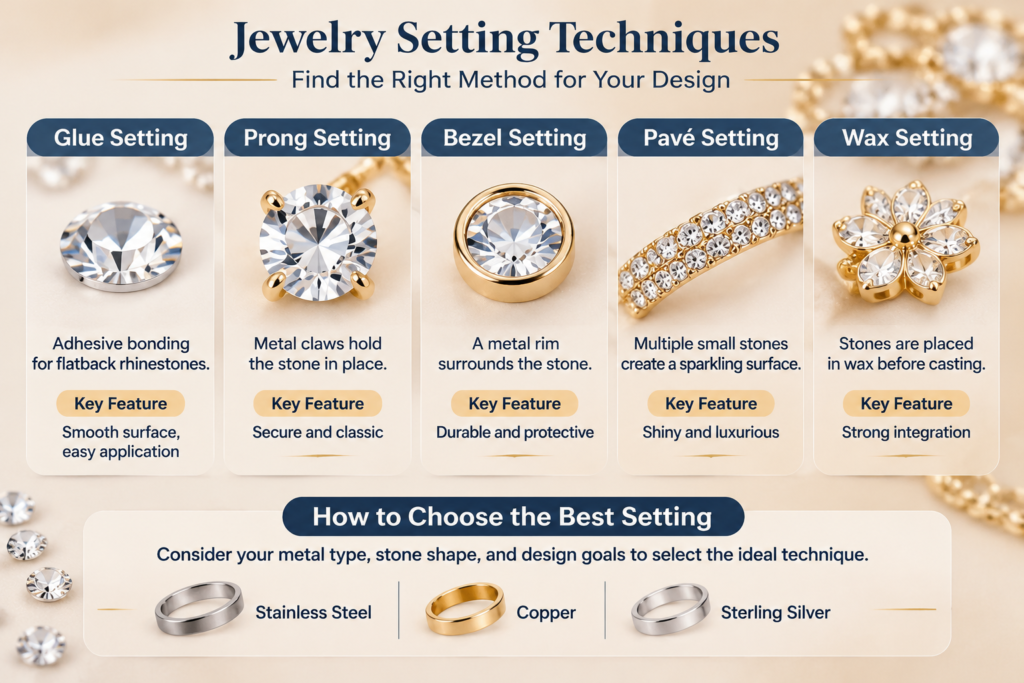
Choosing the Right Setting for Wholesale Jewelry
There is no universal setting method for every fashion jewelry design. Manufacturers should evaluate metal properties, stone shape, production volume, appearance, and expected wearing conditions before selecting a process.
For wholesale rhinestone jewelry and custom jewelry manufacturing, the right combination of metal, stone, and setting technique helps balance appearance, production efficiency, and product quality.
Ultimately, successful fashion jewelry manufacturing is not simply about choosing the lowest-cost process. It is about matching material properties and manufacturing capabilities to the product’s design and market positioning.