
In the world of high jewelry and fine watches, a recognizable motif often speaks louder than a logo. These symbols are not decorative coincidences; they are carefully cultivated visual languages that express heritage, craftsmanship, and philosophy. At the heart of every enduring maison lies a powerful luxury brand visual identity, distilled into a single, unforgettable form.
The Panther and the Serpent: Power in Motion
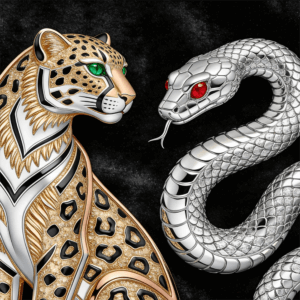
Few symbols convey strength and elegance as vividly as the feline predator. Cartier panther jewelry embodies wild beauty, independence, and controlled power. Introduced in the early 20th century and championed by Jeanne Toussaint, the panther evolved into Cartier’s spiritual emblem—sensual yet commanding, decorative yet deeply symbolic.
Equally hypnotic is the serpent. The Bulgari Serpenti collection draws on ancient Greco-Roman mythology, where the snake symbolized rebirth and eternity. Through the innovative Tubogas technique, Bulgari transformed the serpent into a fluid, architectural form that coils around the wrist, merging sensuality with technical mastery.
Luck, Keys, and Flowers: Symbols of Emotion and Belief
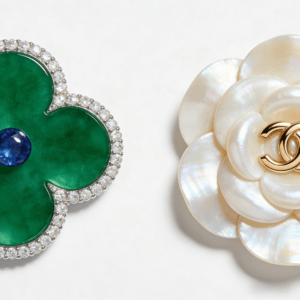
Symbols also serve as vessels of hope and intimacy. The enduring popularity of Van Cleef & Arpels’ clover lies in its layered symbolism. Understanding the Van Cleef Alhambra meaning—luck, health, wealth, and love—reveals why this motif transcends trends and generations.
Similarly, the Tiffany key necklace meaning goes beyond ornamentation. Inspired by antique keys, it represents unlocking possibilities, dreams, and emotional milestones. It is a poetic object, designed to open not doors, but moments.
Floral motifs carry equal emotional weight. Chanel camellia jewelry reflects Gabrielle Chanel’s devotion to purity of form and understated rebellion. The camellia’s symmetry and lack of scent aligned perfectly with her rejection of excess and her pursuit of timeless elegance.
Breaking Rules and Honoring Roots
Some icons redefine tradition altogether. The Boucheron question mark necklace, created in 1879, challenged the very structure of fine jewelry by eliminating clasps and symmetry. It remains a landmark of creative audacity and intellectual curiosity.
Others are rooted in family and land. Piaget rose jewelry pays tribute to the rose gardens of the Piaget family estate, symbolizing love, life, and artisanal excellence expressed through precious metal and gemstones.
Geometry, Heritage, and Modern Love
History and geometry converge in Chaumet Bee My Love, inspired by Napoleon’s imperial emblem and the hexagonal structure of honeycombs. The motif represents unity, protection, and enduring bonds—reimagined through contemporary design.
Why Motifs Matter
These icons endure because they compress complex narratives into instantly recognizable forms. For emerging brands, the lesson is clear: a successful motif is not invented overnight. It is discovered—through history, philosophy, experimentation, and resonance. When a symbol truly aligns with a brand’s core, it becomes more than design. It becomes destiny.