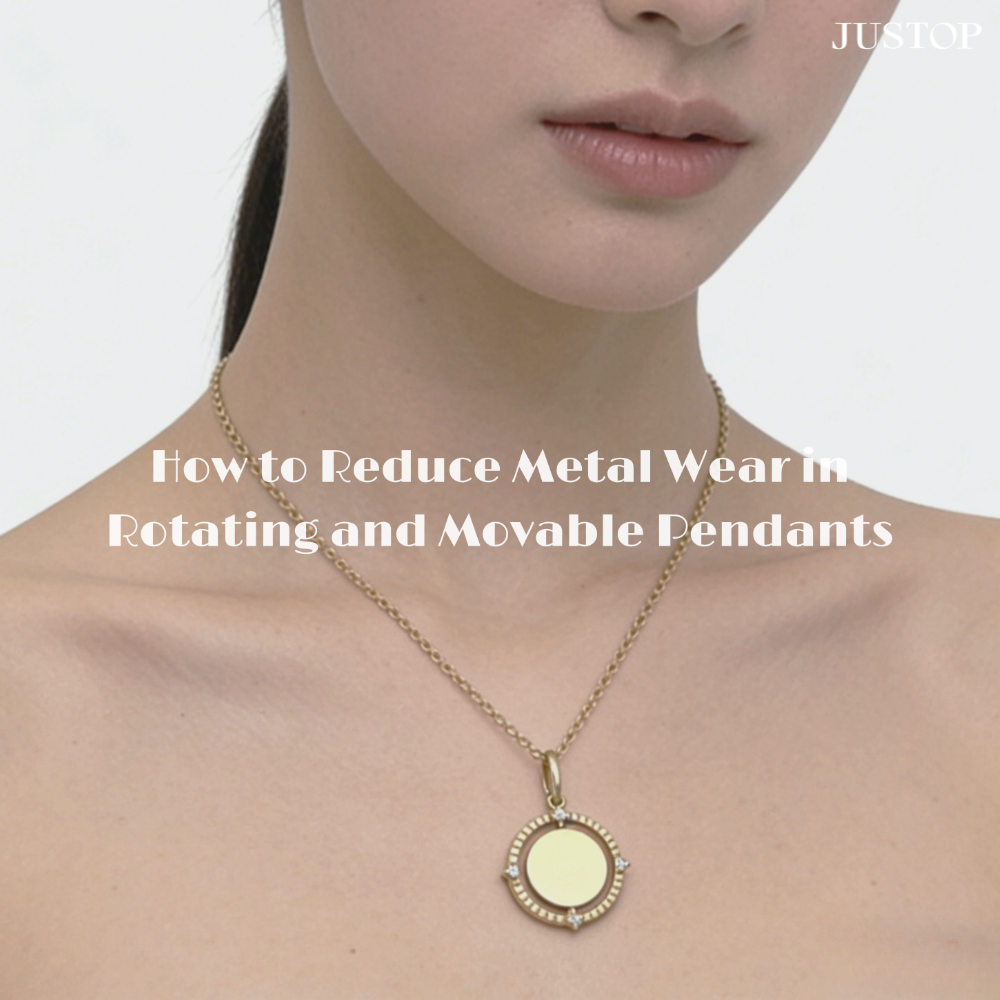
Movable jewelry such as a Rotating Pendant or a rotating pendant necklace brings life, motion, and interaction to traditional designs. From a rotating diamond necklace to other forms of motion jewelry and interactive jewelry, these pieces captivate wearers through movement. However, constant motion also introduces a technical challenge: metal wear. Reducing wear requires thoughtful design, proper material selection, precise craftsmanship, and ongoing care.
Design Optimization: Solving Wear at the Source

The most effective way to reduce wear begins at the design stage. In articulated jewelry and kinetic jewelry, friction typically occurs at joints and connection points.
One proven solution is adding buffering structures. Micro silicone or PTFE washers can be embedded at joints to prevent direct metal-to-metal contact. For more advanced innovative jewelry design, replacing simple rings with miniature bearing systems transforms sliding friction into rolling motion—ideal for high-end rotating pendant necklace designs.
Limiting excessive movement is also critical. Structural limiters or recessed grooves can control swing angles, preventing repeated impacts between interlocking components. Additionally, shaping contact surfaces into gentle curves or angled planes reduces pressure concentration and slows long-term wear.
Material Selection: Let Materials Work Together
Material compatibility plays a major role in durability. Using metals with different hardness levels—such as pairing stainless steel jewelry parts with softer gold alloys—helps minimize abrasion at contact points.
For high-stress areas, advanced surface treatments significantly improve longevity. PVD coating jewelry applications enhance hardness and resistance to scratching, while ceramic coating jewelry offers exceptional wear resistance for rotating or load-bearing components. These treatments are especially valuable in premium motion-based designs where visual perfection must be maintained over time.
Craftsmanship and Assembly Precision

Even the best design can fail without proper execution. Precision tolerance control is essential for rotating pendant mechanisms. Excessive gaps lead to impact wear, while overly tight joints increase friction. A clearance range of approximately 0.1–0.3 mm typically allows smooth motion without instability.
Lubrication is another often-overlooked factor. Applying a small amount of jewelry-grade or watch-grade lubricant to moving joints reduces friction and protects surfaces. Ordinary oils should be avoided, as they attract dust and accelerate wear.
Jewelry Maintenance Tips for Long-Term Performance
For wearers, proper care completes the durability equation. Avoid wearing motion jewelry during sleep or physical activity, and store pieces separately to prevent friction with other items. Regular gentle cleaning removes dust particles—one of the main contributors to hidden abrasion.
Professional inspection every one to two years allows jewelers to reapply lubrication, replace worn buffers, and ensure interlocking components remain aligned.
Metal wear in rotating and movable jewelry is inevitable, but it can be dramatically reduced. By combining intelligent structural design, compatible materials, precision craftsmanship, and informed care, designers can create Interactive Jewelry that moves beautifully and lasts. For high-value or frequently worn rotating pendants, solving wear at the design stage is always the most effective approach.