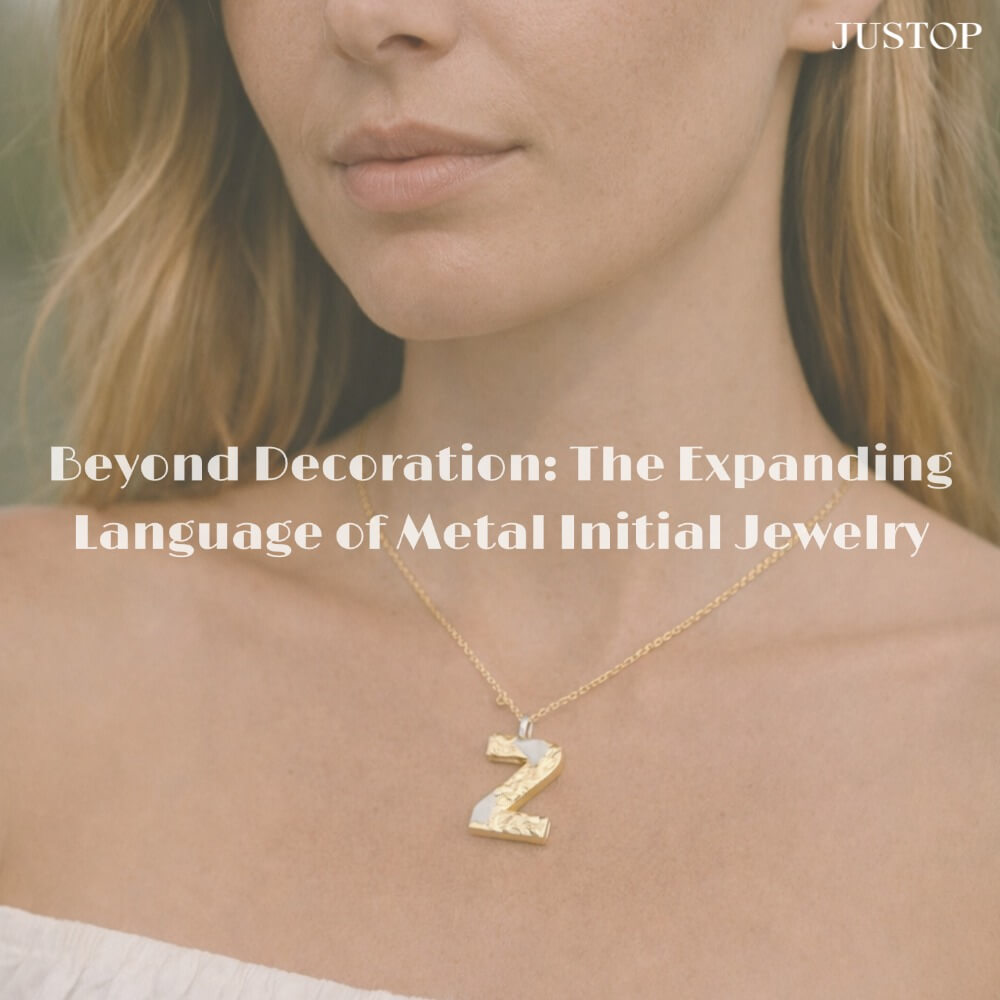
Metal letter jewelry has evolved far beyond simple personalization. What once focused mainly on surface decoration—such as stone setting or enamel filling—has now transformed into a multidimensional design field. Today’s initial jewelry, letter jewelry, and alphabet jewelry explore structure, material, movement, and concept, turning letters into expressive design objects rather than static symbols.
This shift reflects a broader trend in contemporary jewelry: letters are no longer just worn to represent a name or memory, but to communicate ideas, emotion, and design intelligence.
Structural Innovation: Giving Letters a Body
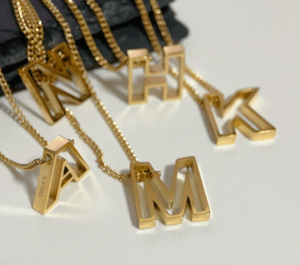
One of the most striking developments is the move toward three-dimensional form. Designers are increasingly creating 3D letter pendants with depth, internal space, and architectural presence. Hollow constructions allow light to pass through, creating subtle shadow play that recalls miniature architecture—an approach closely aligned with architectural jewelry.
Movement is another key innovation. In kinetic jewelry, letter strokes are articulated with joints, allowing parts of the letter to move gently with the wearer. Some designs even incorporate opening mechanisms, transforming an initial pendant into a tiny container or secret compartment. These interactive structures blur the line between jewelry and object design, laying the foundation for truly interactive jewelry.
Surface and Texture: Material as a Visual Language
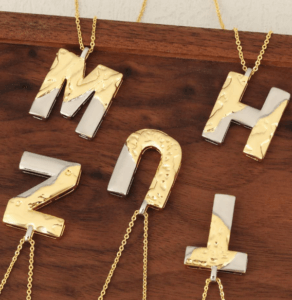
Texture has become a powerful storytelling tool. Contrasts between mirror polish and brushed metal jewelry finishes create refined visual tension, while hammered metal jewelry embraces irregularity and the trace of the hand. These tactile surfaces introduce warmth and individuality that machines cannot replicate.
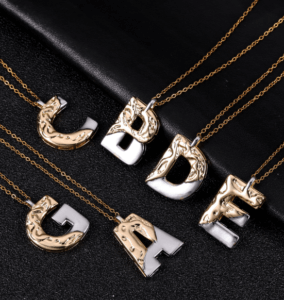
Material combinations further expand expression. Metal and stone jewelry uses natural stone slices or inlays to give each letter a unique visual fingerprint, while wood and metal jewelry plays with the contrast between organic warmth and industrial coolness. These combinations make each piece feel less like a product and more like a one-of-a-kind object.
Conceptual Expression: When Letters Become Ideas
Beyond form and texture, many designers treat letters as a conceptual medium. Negative space jewelry defines letters through absence rather than presence, allowing skin or fabric to complete the form. Others translate language into code: Morse code jewelry and Braille jewelry turn letters into patterns of dots and lines, readable only to those who understand the system. This approach adds intimacy, privacy, and intellectual depth, positioning letter jewelry firmly within the realm of conceptual jewelry.
Wearability and Transformation
Modern letter pieces are also increasingly adaptable. Modular jewelry allows letters to be rearranged or recombined, while convertible jewelry enables a single piece to shift between necklace, bracelet, or brooch. Even classic personalized letter jewelry, such as a custom initial necklace, is now designed with flexibility and interaction in mind.
A New Future for Letter Jewelry
In today’s design landscape, letter jewelry is no longer about decorating a symbol—it is about experimenting with meaning. Through structure, texture, material dialogue, and interaction, letters become emotional objects with presence and personality. As technology and personalization continue to advance, the visual language of metal letters will only grow richer, more expressive, and more surprising.